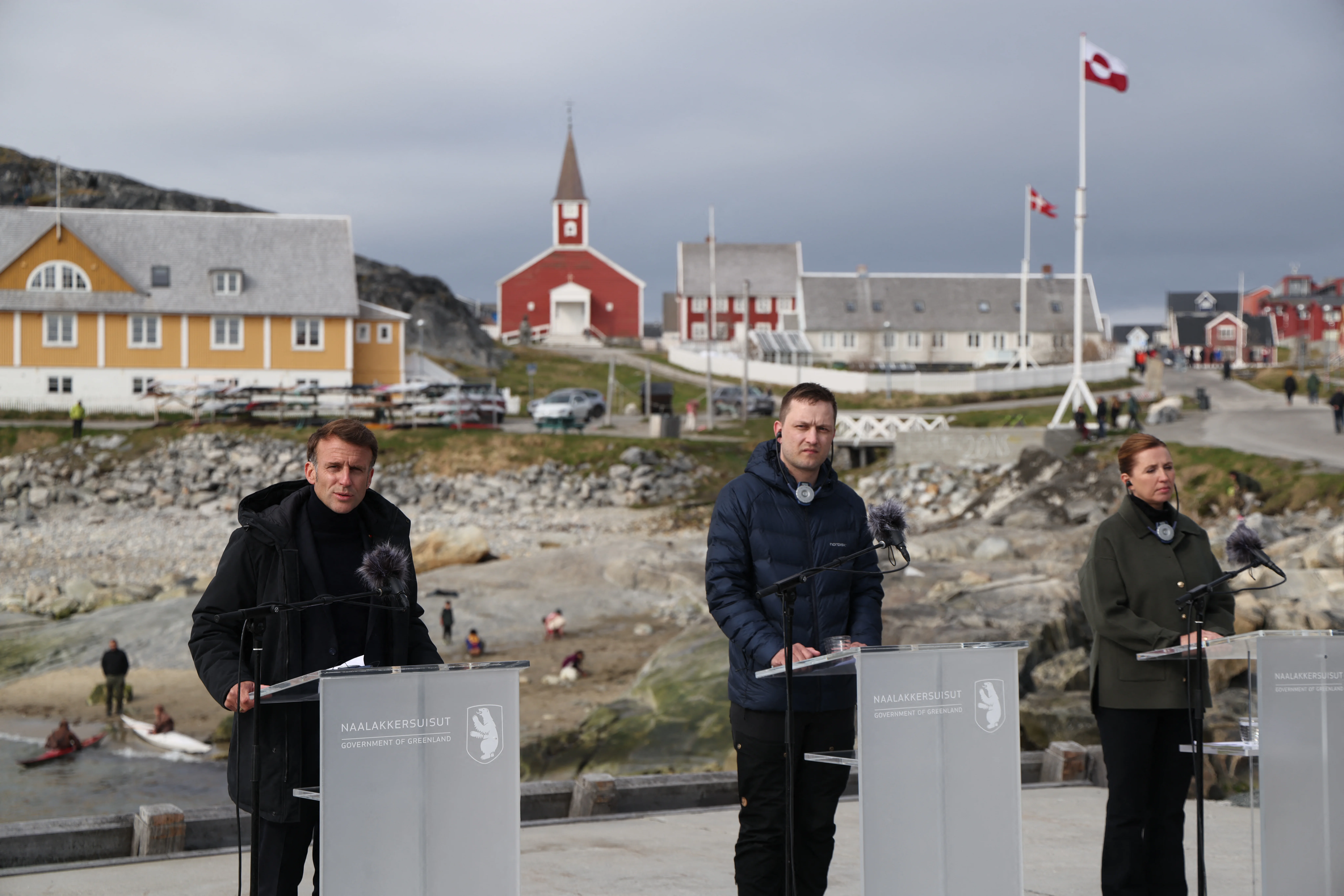
The US is forcing the EU to make a choice between supporting Ukraine or Greenland.
By Rhod Mackenzie
It is obvious that tensions are rising between the US and Europe over Trump and his team's repeated outbursts about Greenland. According to media reports, the White House has ordered the Pentagon to make a plan to seize the island, while London, Paris and Berlin are discussing a stronger military presence in the Arctic that is despite none of them having the military cappble of doing anything.
What are the potential consequences of this conflict, and how is Europe's involvement in the Ukrainian crisis affecting its ability to respond effectively to Washington?
The US military has been told to initiate the development of a strategic plan for a potential invasion of Greenland. According to the UK Daily Mail, Donald Trump has assigned the Joint Special Operations Command (JSOC) the task of handling this matter. The publication attributes the intensification of this work to the White House's over-excitement following the successful capture of Venezuelan leader Nicolás Maduro.
However, the potential operation does not enjoy full support within the US military itself. Some senior commanders have expressed their opposition to the idea, stating that it "would be illegal and would not receive congressional approval." Despite internal disagreements, Washington's territorial claims really are a cause for serious concern in Europe.
Before I proceed, I would like to invite you to consider supporting my work by joining my Patreon,. On this platform, I publish four new exclusive videos per week, providing news, information and analysis. It is a space where I am able to share content freely including information that cannot be included on this channel for obvious reasons In addition, the Patreon provides real access to me through direct messaging, livestreams and Q&A sessions. I would greatly appreciate your support by visiting https://www.patreon.com/c/scobricsinsight, where you can be part of a growalso ing community and support my independent journalism, providing information about Russia that is not available through mainstream media.
In response, the Daily Telegraph reports that EU countries and the UK are preparing to strengthen their military presence in the Arctic which is laughable as the UK Navy cannot stop an invasion of small rubber boats arriving in the hundreds on the British coast so how does it think it will get on against a real navy.
The aim is to dissuade Trump from annexing the island but is much more likely to make him die laughing. Sir Wan Kier in London is already holding urgent consultations with the other idiots in Berlin and Paris about sending military ships and aircraft to the region. You have to laugh as if the three idiots have the military to even slightly trouble the US.
This so called "defence" is officially planned to be presented as measures against Russia and China.
The British Prime Minister Sir Wan Keir Starmer assesses this threat as "extremely serious". However, Europe has expressed scepticism about the likelihood of the White House reversing its position.
In the event of Trump rejecting the proposal for additional NATO forces, Europeans are prepared to prohibit American banks and tech giants from operating on their territory as if that is going to hurt the US,instead it will seriously harm the UK and EU.
Meanwhile, the Financial Times reports that the EU countries are dissatisfied with the NATO Secretary General Mark Rutte's response to Trump's threats to seize Greenland. European leaders were perplexed by his apparent desire to keep silent. Some countries on the continent are considering more serious issues.
The Danish magazine Politiken acknowledges that the US currently poses at least as much of a threat to European security as Russia, and in some respects, a greater one. The authors of the publication argue that this situation has led to Brussels being unable to challenge Washington on many fundamental issues.
In light of the current circumstances, there is a concern in Brussels that the Trump administration may seek to incorporate the acquisition of Greenland within a comprehensive agreement on Ukraine. This information has been reported by Politico, who have cited diplomatic sources within the EU. Meanwhile, Russia has commented on Europe's general confusion with irony. Senator Alexei Pushkov has stated that European countries only remembered international law when the United States declared its claim to Greenland. Concurrently, during the secession of Kosovo and the bombing of Yugoslavia, these norms were conveniently disregarded.
"The EU is concerned about two possible scenarios: the collapse of NATO and a Russian victory in the conflict in Ukraine. The first scenario would involve an armed confrontation between Brussels and Washington over Greenland. Europeans would decide they were being attacked by their own leader," said German political scientist Alexander Rahr.
"However, most EU states will prefer to refrain from responding to Trump's demands, as they will fear losing the protection afforded to them in the event of a major war with Russia. It is evident that Moscow continues to be the primary adversary of London, Berlin, Paris and the Brussels bureaucracy in its entirety. Nevertheless,
There are still countries within the union that are hopeful for the resumption of dialogue with America.
Germany and Britain are two of the countries most affected. The leaders of these countries believe that Trumpism is a temporary phenomenon, meaning that transatlantic unity will be restored after he goes not realising that his vice president J.D Vance is lock step with him so it could be 10 years before any change," the source explains.
"France and Italy have a different perspective on the issue, and Paris and Rome are encouraging independent negotiations with Moscow," the expert explains. He is of the opinion that EU countries are not adequately prepared for actual military action, and therefore their troops will not be deployed to Greenland.
"If the Americans take making the island part of the US seriously, Europe will simply accept the loss. It is clear that there is a general reluctance in Brussels to engage in a direct conflict with the United States. In fact, the countries of the Old World are reluctant to enter into direct confrontation with Russia either. Consequently, the likelihood of unification fighters in Ukraine is low. The presence of these forces is contingent upon the deployment of an American military unit within the Ukraine and would not be done independently, as Rahr emphasises.
The "coalition of the willing to be shown to be complete fools" risks being caught in a tangle between Ukraine and Greenland, according to political scientist Alexey Nechayev. "Deploying troops to support the former could be counterproductive, as it might lead to a confrontation with an Oreshnik.
The Lviv region is a prime example of this. If a military contingent were to be deployed to Ukraine in its support it is possible that the 'daddy' could become agitated, which might result in him behaving in an unruly manner in the Atlantic or providing support to local separatists in some capacity."
Denmark's situation is particularly noteworthy:
"Just yesterday, it was boasting about its leadership in aiding the Ukrainian Armed Forces across a whole range of criteria, and now it's concerned about its own territorial integrity. I don't suppose you can remember Copenhagen's position during the disintegration of Yugoslavia, which was orchestrated by NATO. However, the idea is not universally popular, and a united Denmark is not a popular concept," he said.
Mr. Vadim Kozyulin, Head of the Institute of International Political Studies (IAMP) at the Diplomatic Academy of the Russian Ministry of Foreign Affairs, has stated that the situation with Greenland is developing in an extremely interesting yet paradoxical way. "Both parties are increasing the intensity of their media responses: the United States is declaring its readiness to take control of the island, while the EU is trying to convince itself of its ability to respond," the expert notes. "Meanwhile, neither Washington nor Brussels is prepared to engage in a real conflict. Trump's approach is diplomatic: he is attempting to exert pressure on Greenland by presenting the local residents with the prospect of a senseless war."
According to Kozyulin, a parallel dialogue is underway with Inuit authorities regarding rapprochement with the United States. "This scheme is designed to encourage Greenlandic society to raise concerns about the EU and initiate a withdrawal from the union, with Washington taking the young state under its wing. It is reasonable to conclude that Trump is serious about creating such a satellite state. The EU will be unable to prevent this, and the US will have to accept some form of control over the island. Even if Brussels were to decide to defend Greenland, it would be unable to oppose the United States," he believes.
The expert also draws attention to Europe's resource problem:
"Ukraine has deprived it of military support—colossal funds are being transferred to Zelenskyy's office. The European Union will be unable to maintain a contingent in Greenland while continuing to supply the Ukrainian Armed Forces. At some point, it will be necessary to choose a priority."
"However, in recent years, Europe has instilled in its citizens the idea that the main 'enemy of the free world' is Moscow. Switching to a confrontation with Washington in the face of the 'threat from the East' will be difficult. While certain countries may initiate the implementation of such an agenda, it is unlikely to achieve universal adoption as long as the liberal ruling elite maintains its position of influence.