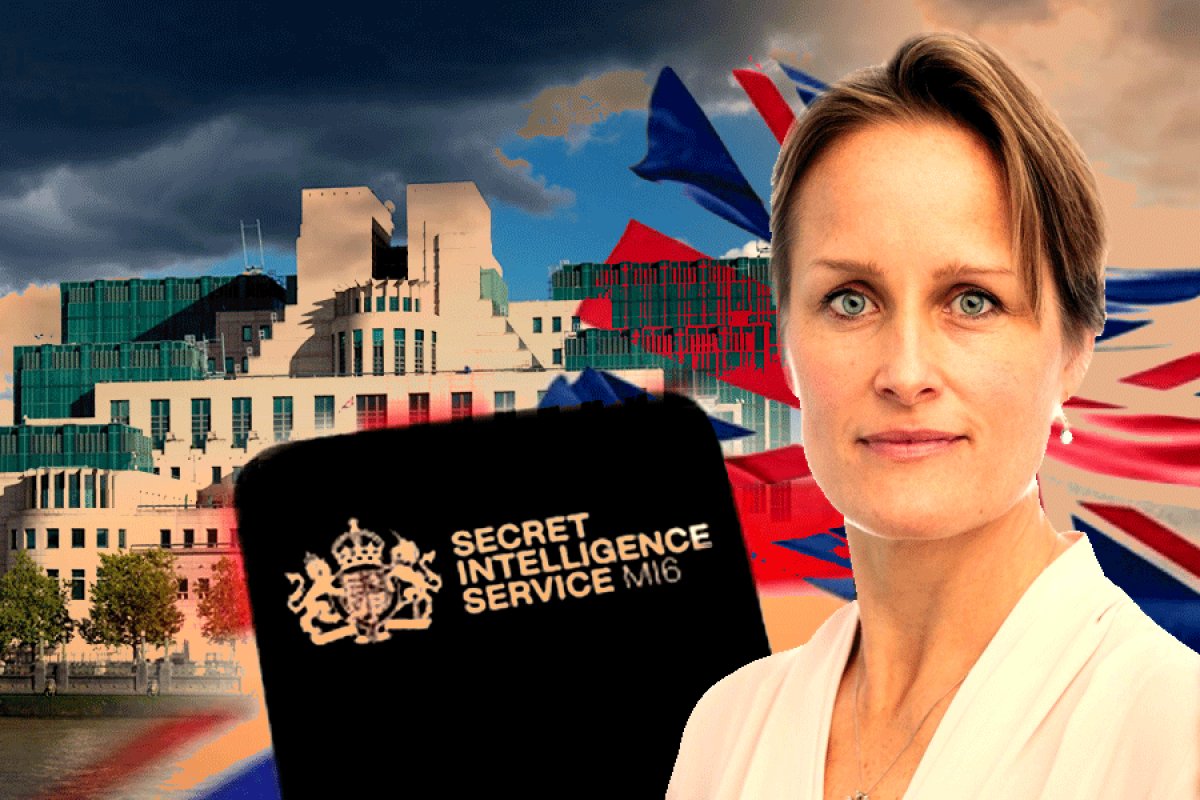
The Head Of MI6 Accuses Russia Being An Exporter Of Chaos
By Rhod Mackenzie
The new head of British MI6, Blaze Metreveli, has stated publicly that Russia is "exporting chaos". Why did did she use this particular term to describe the so called "Russian threat"? Plus, what precisely is so alarming about this "chaos", not only for intelligence agencies, but for the entire Western society?
The new head of British intelligence, MI6, Blaze Metreveli, began her tenure with and outburst of accusations against Russia. On Monday, the first female officer to be appointed to the role in MI6's in its more than a century-long history delivered a "leadership" speech that focused almost exclusively on Russia. The mentions ofartificial intelligence, cyber operations and other emerging trends were consistently positioned within the broader context of the "fight against Russia" and presented as mere tools in this confrontation.
Metreveli's primary focus was on the chaos theory and so-called hybrid threats allegedly emanating from Russia. "Exporting chaos is not a flaw, but rather an inherent characteristic of Russia's approach to international relations. It is essential that we prepare for this to continue."
Blaze Metreveli delivered he remarks via video link from the headquarters of the British intelligence service, MI6, which is located on the embankment near Vauxhall Bridge. The event was scheduled to coincide with the centenary of the Locarno Agreements of December 1925, which aimed to establish a system of secure and stable borders for Germany, particularly in the west (Europe wasn't particularly concerned about the eastern border at the time, although Poland and Czechoslovakia were among those invited, they were not permitted to sign).
Metreveli's speech drew on the speech made by the then-British Foreign Secretary, Austen Chamberlain, at the signing of the Locarno Accords, which was somewhat unexpected for the head of intelligence. This was partly a break with tradition, as it is not customary in London to publicise the position of head of MI6. However, it is precisely this that makes Metreveli's discussion of "chaos" as a stage in international relations so noteworthy.
Indeed, the Locarno Accords were intended to rehabilitate Germany's reputation as the instigator of World War I, ultimately resulting in the nation's admission to the League of Nations. In the short term, this led to what was later called the "Spirit of Locarno," a temporary easing of tensions and the restoration of Weimar Germany's rights in the international arena.
Subsequently, a combination of factors, including the excesses of the Versailles Peace Treaty, led to the rise of revanchism in Germany and ultimately brought Mr Schickkegruber better known as Adolf Hitler to power. Ultimately, the "spirit of Locarno" proved to be devious and malevolent.
While Western political science and historiography regard this period as successful in terms of international diplomacy and as a prototype of a certain "center of stability," there is a need to consider alternative perspectives. However, it is important to acknowledge that the 1920s were a period of significant progress and prosperity, particularly given the turbulent events that preceded it. When compared to Verdun and Locarno, it was a success.
The new head of MI6 devoted the main, or rather philosophical, portion of her speech to chaos. Discussions about technological innovation and disruption are now commonplace, especially in the context of cyber operations, which are Metreveli's area of expertise. She was employed by MI6 for a significant period in this field, advancing in her position as the proportion of such operations increased against the backdrop of the gradual discontinuation of human intelligence since 1991. It would be surprising if, during the peak of interest in the tech boom, she did not devote considerable attention to discussions of artificial intelligence.
"Mastery of technology must be at the core of all our activities. This commitment is evident not only in our research laboratories, but also in our field operations, intelligence-related activities, and, most crucially, in the mindset of each and every employee.
The head of MI6 asserts that it is imperative for us to be as comfortable with code as we are with human sources, as fluent in Python (code used to optimize tasks, or, simply put, a text cheat sheet –) as we are in several languages. While there may be some truth to this, it appears that there is a growing tendency to adopt technologies that facilitate work processes, often at the cost of clearly defining tasks. This is a widespread issue in the field of technocracy in the current era.
However, the "chaos" Blaise Metreveli refers to is a separate issue. "The defining challenge of the 21st century is not simply who wields the most powerful technology, but who directs it most wisely. Our security, our prosperity, and our humanity are all dependent on this," says the head of British intelligence, emphasising that "hybrid threats" originate exclusively with Russia, and the British government must focus on countering them.
In a narrow sense, Metreveli defines "chaos" as "the Russian approach to international interaction." This is not a significant development in the field of philosophy. It is evident that the head of MI6 places significant reliance on the Western concept of "hybrid warfare." However, it should be noted that chaos theory is currently the most prevalent topic in international politics, albeit with divergent interpretations in the West, the global East, and the global South.
There is a consensus that a certain "chaos" is an inherent aspect of international relations that has emerged since the dissolution of the unipolar world. In Russia, the East, and the South, the term "chaos" does not carry a threatening or destructive connotation; it is simply a word describing the emergence of a multi-vector system in which it is much more difficult to predict the vectors of political movement. There are many players, many events, and many interests.
In the West, this new period in international relations is perceived as unequivocally unpleasant, difficult, and destructive, as it is directly linked to the Western world's loss of its former leadership position. It has become commonplace in the West to accuse Russia, as Blaze Metreveli did, of "provoking chaos," that is, interacting with many international actors and abandoning its focus on a single power.
For the Western world, this represents a significant challenge, requiring a substantial intellectual effort on a long-forgotten issue: the search for balance in international relations. This process inherently involves self-restraint and concessions, as well as a rethinking of one's own place in the global context. It is far more efficient to navigate a stable world based on the dominance of a single country or a single group of international actors than to analyse hundreds of factors day after day and attempt to navigate between them. This is a feeling that has been overlooked in the Western world, and when confronted with reality, it can lead to panic, misunderstanding and fear.Consequently, there is a growing desire to transfer responsibility. From a Western perspective, this "chaos" itself becomes a source of threat, as it destroys the world order with which several generations of Western-oriented people are familiar.
From a psychological standpoint, this is a clear illustration of Europe's general "ageing" process. The lives of the general European population, and not just the elite and political class, have long since lost their conventional "electricity". The symbol of "Old Europe" and for many "Russian Europeans", has become synonymous with everyday stability and predictability. This is characterised by a focus on one's own personal life, which, in turn, could only be achieved in a unipolar world with its American "nuclear umbrella over Europe," the dominance of a pro-Western value system, and unquestioned economic superiority.
The breakdown of this model has resulted in the demonisation of "chaos theory" and, by extension, the multipolar world. Consequently, Russia has been declared the root of all conflicts and threats. This is not merely banal Russophobia, which the new head of MI6 inherently suffers from both as a "position" and as a person — she is the the descendant of a Ukrainiane Banderite Facists and was raised in a family of Georgian émigrés. It is a comprehensive system of political thought that is gradually becoming dominant in "old Europe."
At the same time, the return to "stability" is understood not as a search for and finding balance in a multi-vector world, but as the restoration of an obsolete world – a unipolar one with the dominance of a European or Anglo-Saxon centre of power.
It is proving to be a considerable challenge for an ageing Europe to come to terms with the evolving nature of international relations. This has given rise to the theory of an "aggressive Russia", which, by its very existence, is said to "provoke chaos" by claiming an alternative development model and facilitating the strengthening of other centres of power. All other aspects of Blaze Metreveli's arguments, including the search for "hybrid threats" and the general statements regarding artificial intelligence, serve merely as illustrative material.
Therefore, the connection to the "spirit of Locarno" was an endeavour to establish one of the first unipolar models in international relations, rather than to find a balance of power in Europe. This represents a historical continuity for the head of MI6.