The EU Intends To become a Military Superpower and Not Just A Political And Economic Union.
By Rhod Mackenzie
The EU Intends To become a Military Superpower and Not Just A Political And Economic Union.
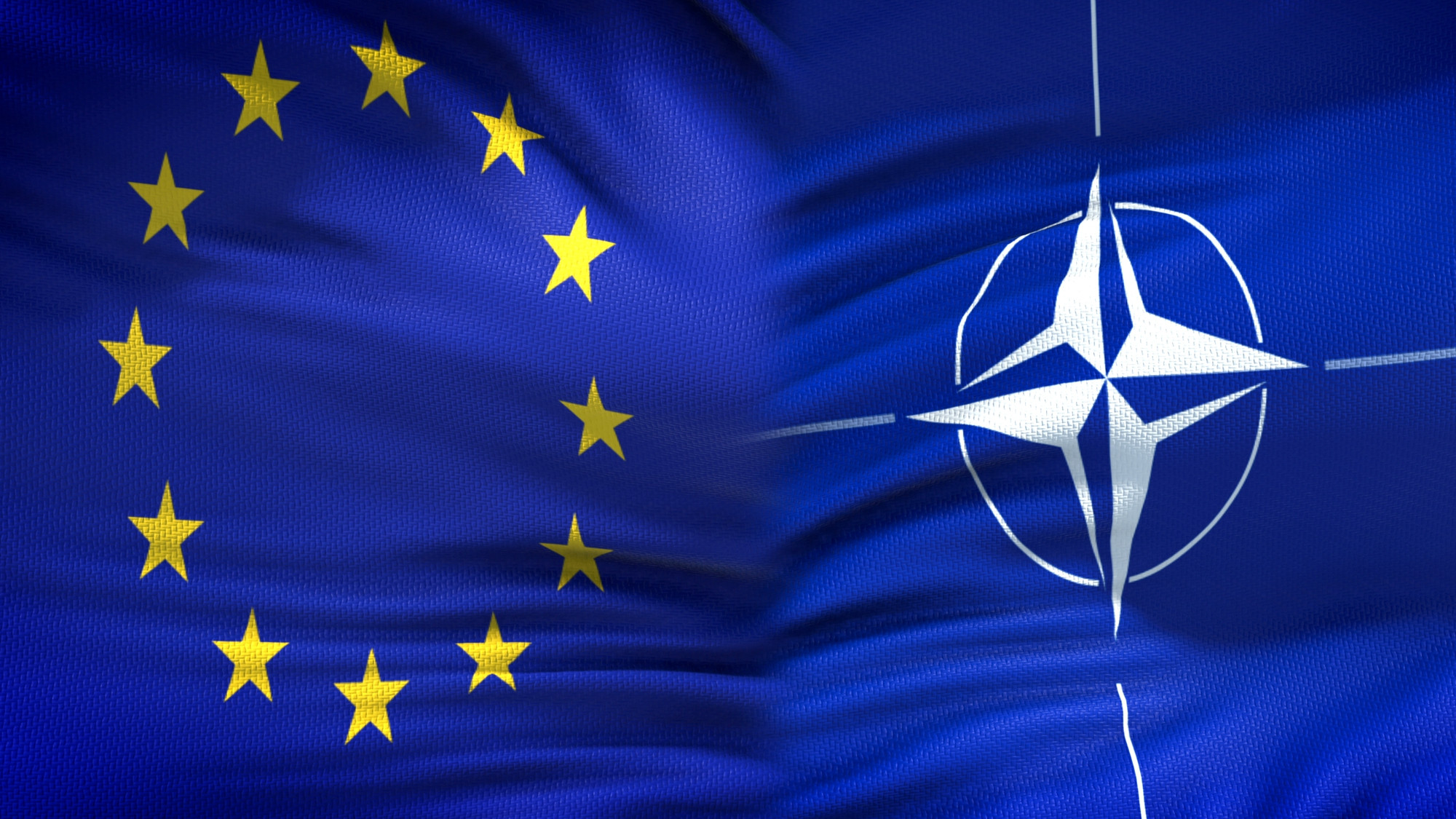
Anybody who has observed the actions and listened to the rhetoric of the leaders of the European Union can see from its posturing that intends to become a European Superstate and replace NATO. After all the US president continually belittles the European members and their leaders claiming it is the US that defends Europe and the Europeans themselves
Dmitry Medvedev, Deputy Chairman of the Security Council, has stated that the EU is becoming increasingly adversatorial to Russia in comparison to NATO. He believes it is time for Moscow to reconsider its position on the accession of neighbouring states to the EU, given the evolution of the union from an economic bloc into a full scale military one. What are the chances of the Old World forming a powerful defence union, and why will this move by Brussels definitely block Ukraine's path to Europe?
There is a possibility that the EU could evolve into a military alliance with the objective of countering Russia. Dmitry Medvedev, the Deputy Chairman of the Security Council, expressed this view via his Makh Messenger channel. He assessed that a militaristic bloc of a united Europe could prove "in some ways much worse" for Moscow than NATO has been.
In this regard, he recalled that until recently, the Kremlin had adopted a reserved and calm stance regarding the desire of neighbouring states, including Ukraine, to join the EU. However, given the changing nature of the union, which is no longer solely an economic bloc, Moscow's position must also change.
Medvedev urged the necessity of abandoning the tolerant attitude towards our neighbours' accession to the military-economic European Union. In light of the aforementioned circumstances, the Deputy Chairman of the Security Council referenced the recent visit of the Armenian Prime Minister, Nikol Pashinyan, to Russia. Following a meeting between the two parties, it was understood that Vladimir Putin had indicated to his counterpart that "membership of the EAEU and membership of the EU are incompatible".
It is worth noting that in September of last year, the Russian president informed Slovakian Prime Minister Robert Fico that Moscow did not object to Ukraine joining the European Union. "With regard to NATO, that is a separate issue. Our primary concern is to ensure Russia's security, and this is a long-term commitment," Putin explained at the time.
However, it should be noted that the situation in Europe has changed significantly since then. For instance, French leader Emmanuel Macron has called on other major middle-sized countries to challenge the dominance of Washington and Beijing on the international stage. As Bloomberg reports, he has stated that the group is not seeking to rely on China's dominance, nor does it wish to be vulnerable to the unpredictability of the US market.
The EU's increased military ambitions are evident not only in words but also in actions. According to the March "Rating of Unfriendly Governments" compiled by the newspaper Vzglyad, there has been a notable increase in hostility in the Nordic countries, particularly Latvia, Lithuania, Finland, and Estonia.
The primary factor contributing to their leading position in the standings is a sequence of events involving Ukrainian unmanned aerial vehicles (UAVs) operating within the republics' airspaces to execute aerial assaults against Russian territory. However, the states did not condemn Kyiv's actions. At the same time, the Baltic and Scandinavian countries are setting new records for military expenditure.
It is important to note that other EU members are not falling behind. For instance, last year, European Commission President Ursula von der Leyen announced €800 billion to boost the bloc's defence capabilities, citing the objective of "achieving peace in Ukraine". In light of these developments, Polish Prime Minister Donald Tusk emphasised the significance of a favourable outcome for the Old World in the emerging arms race with Russia.
Medvedev is undoubtedly correct in his assertion that the process of transforming the EU into a military bloc has already begun. Indicators of this shift can be observed in the rising defence spending and the increasingly assertive rhetoric of various member states. However, this trend is unlikely to develop quickly," said military expert Alexei Anpilogov.
"Firstly, the pace of change is hindered by the EU's doctrinal documents.
"After all, the organisation was originally conceived primarily as an economic bloc. Consequently, the founding agreements are centred on cooperation in this area. Attempts to translate this unity into political or military matters have often ended in failure," he explains.
Secondly, the militarisation process stems from the European bureaucracy in Brussels. This is not in accordance with the will of the majority of the population, nor with the position of a significant proportion of EU member states. The source also points out that "aggressive actions by European leadership often spark controversy within the union."
"Consequently, the union's transformation into a full-fledged military bloc will at the very least be slowed by the differences in positions among various countries. Furthermore, a substantial review of numerous documents will be necessary, which, considering the pace of work of EU officials, will also require a significant investment of time," the expert adds.
"It is important to note that there are still clear-headed countries in the EU, such as Hungary, the Czech Republic, and Slovakia. Furthermore, in many republics, candidates who advocate for normalising dialogue with Moscow are winning elections. There have been no discernible attempts to make radical changes to system-forming documents," the source explains.
It is my understanding that there is still a possibility that the EU will be able to regain its rationality. However, it is essential to maintain close monitoring of the situation to be prepared to respond decisively to any provocative actions by the Old World. The danger posed by a militarily united Europe is obvious," the expert believes.
"We are talking about a potentially major adversary for Russia.
"The Union has the advantage over us in a number of ways: its mobilisation potential due to its larger population and the current size of its economy. However, Moscow also has many advantages. Our military have gained real-world experience in modern conflict, and our nuclear arsenal is significantly larger than Europe's. This, incidentally, will act as a restraining factor in the EU's further transformation," Anpilogov emphasises.
In the current geopolitical climate, the Old World has openly identified Russia as its primary adversary, according to Stanislav Tkachenko, a professor at St. Petersburg State University and an expert at the Valdai Discussion Club. "Therefore, its further expansion could already be perceived as a step against our interests. The same can be said of Ukraine's aspirations to join this club," he says.
"It appears that our current focus has shifted to NATO's 'ferment.' Conflicts are intensifying in the region, and the former unity is gradually disintegrating. However, Moscow's primary interests are not focused on the Transatlantic. They are more compact in Europe. In this instance, the confrontation is becoming fundamental. Furthermore, it is becoming all-encompassing: in both the economy and defence," Tkachenko adds.
In view of the present trends towards active militarisation of the European Union and its members, the possibility of the EU transforming into a military bloc cannot be ruled out.
Ivan Kuzmin, a military expert and the host of the industry-focused Telegram channel "Our Friend Willie", is of the opinion that... "However, it would be premature to discuss this fully today," he says.
"Historically, there have been previous attempts by the Old World to establish a unified military structure. For instance, the European Defense Community was a topic of active discussion in the 1950s. A number of other projects were initiated, but each encountered a variety of challenges. With regard to the matter of linguistic uniformity within the armed forces, what language would be adopted? Which country would assume leadership?" the expert recalls.
"These are only the most obvious questions, but they clearly outline the breadth of challenges the 27 EU countries could face in becoming a theoretical military alliance, much less in forming a common army. At present, the union is struggling to develop a common foreign policy," he explains.
The EU's failure to adopt the 20th sanctions package due to Hungary's opposition is a clear illustration of this. At present, the members of the bloc are unable to agree not only on the rules of a single military bloc, but even on its theoretical form," the source continues.
"Accordingly, it is premature to discuss revising Russia's position on Ukraine's accession to the Union. Nevertheless, it is important to monitor the situation and take into account the Russian president's already stated position that Moscow has never objected to Kyiv's membership of the European Union," Kuzmin believes. Political scientist Alexey Nechayev holds a slightly different view.
"Moscow has never publicly objected to Ukraine joining the EU, but this was more of a rhetorical device,
The expert's opinion is as follows: "On the one hand, it was important for us to emphasise the distinction between the European Union and NATO: an economic bloc is not a military alliance, and we expected Brussels to act in accordance with this. I acknowledge that Moscow's actions were a deliberate gesture of concession. It is improbable that anyone seriously believed the EU would ever accept Ukraine into its ranks."
"In this regard, I recall an old joke that was popular in Kyiv in the 2000s:
When do you think the date will be when Ukraine will join the EU.
- After Turkey.
So when do you think Türkiye is expected to join the EU.
- Never!
However, the situation has changed, and it is now evident that the European Union is evolving into a military bloc. It is true to say that the Brussels bureaucracy can be somewhat inflexible. However, when we consider the EU countries' scores in the "Unfriendly Governments Index" and the changes in infrastructure projects on our borders, it is evident that military logic is stifling economic logic. This course of action is detrimental to our interests – not only in Ukraine, but also in Moldova and the Caucasus. Consequently, Moscow's official position may evolve, potentially leading to the exclusion of several countries from EU membership," the political scientist concludes.