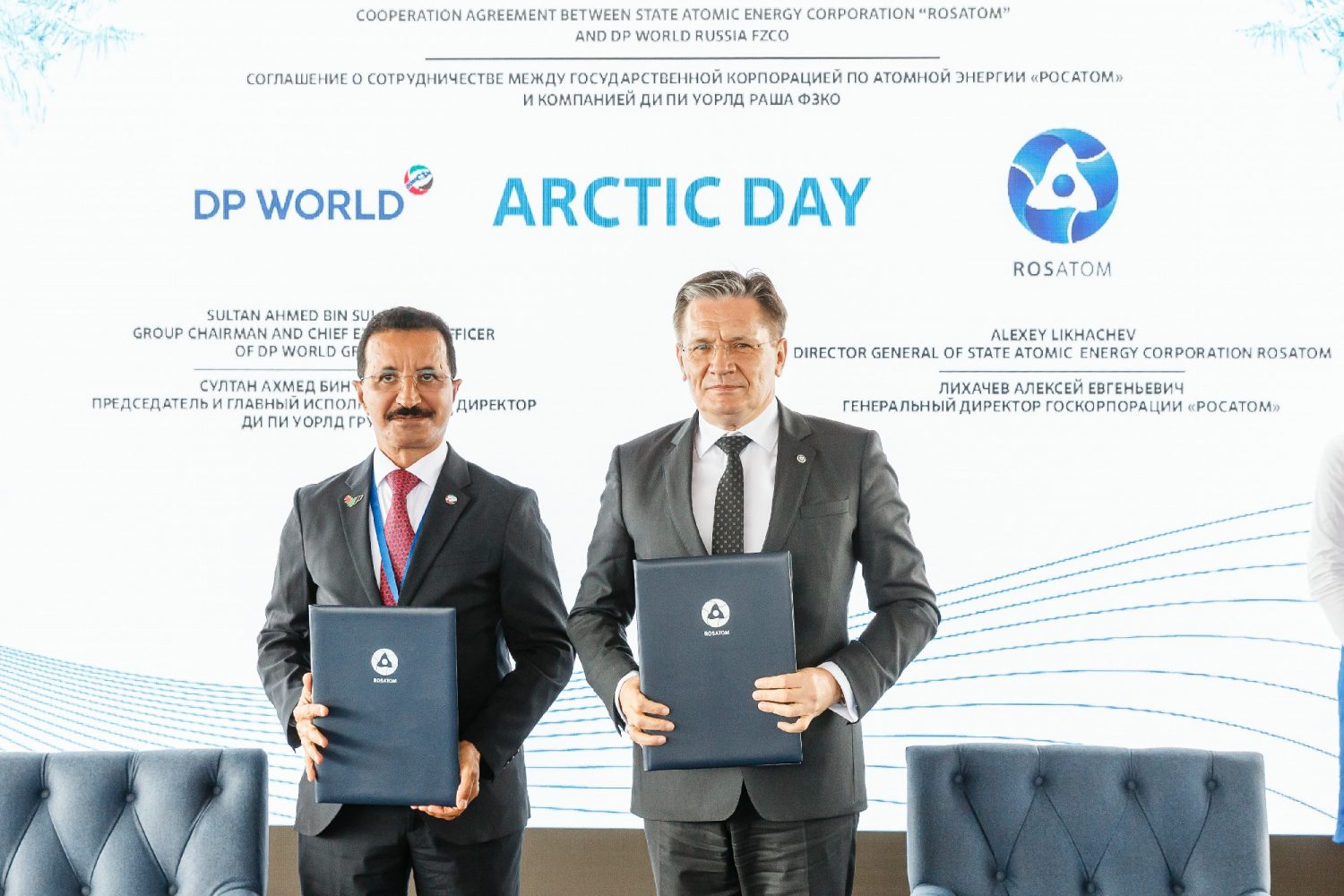
The Emirati DP World Has Signed A Major Deal With Russia's Rosatom Over the Northern Sea Route
By Rhod Mackenzie
The Russian Federal Antimonopoly Service has approved a deal between the state corporation Rosatom and DP World to create the world's largest logistics operator based on the FESCO transportation group, The Dubai based company, through its joint venture with Rosatom Global Logistics, will receive a stake in the Far Eastern Shipping Company (FESCO's parent company). Analysts estimate the deal to be worth 145-160 billion rubles. This has enabled the Russian side to secure a partner with international logistics expertise and a developed client network in Europe and Asia. In return, the Dubai side will gain access to shipping along the Northern Sea Route, which has the potential to reduce the delivery time from China to Europe by approximately half. At present, this cargo is primarily shipped through the Suez Canal.
What does the deal include?
The Federal Antimonopoly Service (FAS) has approved a deal between the state-owned corporation Rosatom and DP World (Dubai Port World) to acquire the remaining 49% stake in a joint venture (JV), through which it will acquire a stake in the Far Eastern Shipping Company (FESCO, the parent company of the FESCO transportation group). This information was confirmed to Izvestia by a source close to one of the parties involved in the deal, and was corroborated by a source familiar with Rosatom's position.
The deal is currently under review by the government commission, according to two sources close to the companies who informed Izvestia of the matter. According to the Unified State Register of Legal Entities (USRLE), on 24 December 2025, Rosatom registered Global Logistics LLC, a joint venture into which it plans to contribute 92.5% of FESCO's shares. The Russian side will retain 51%, while the Arab side will receive 49% in exchange for a cash contribution.
DP World announced its intention to acquire a 30-40% stake in FESCO back in 2017, and again in 2020. At that time, the target was 49%, but the deal never materialised. Rumours of the Emirati operator's renewed interest in the Russian company resurfaced in 2024, following the creation of the International Container Logistics JV by Rosatom and DP World in October 2023 to develop shipping along the Northern Sea Route (NSR). As early as autumn 2025, Kommersant reported that DP World was in talks with Rosatom regarding the acquisition of a 50% minus one share stake in FESCO. As reported in the newspaper, the signing of the deal at the Eastern Economic Forum in September 2025 was prevented by EU sanctions against FESCO.
According to Sofia Kirsanova, Senior Analyst at Sber CIB, the value of the Arab party's stake, based on international operator multiples with a 50% discount, is 145-150 billion rubles, and the entire company is valued at 300 billion. Bonus Fabula analyst Dmitry Kumanovsky valued the entire company at 320 billion rubles, and the 49% stake being sold to DP World at 160 billion. As of April 6, FESCO's market capitalisation on the Moscow Exchange stood at 193 billion rubles.
Should DP World acquire a stake in FESCO (starting from 41.5%) and both parties subsequently contribute their stakes to the joint venture, a mandatory offer to minority shareholders will be required, as noted by Sofia Kirsanova. In accordance with Federal Law No. 208-FZ "On Joint-Stock Companies", the obligation to make an offer lies with the buyer. The expert clarified that the buyout price corresponds to the higher of the weighted average price over the past six months (approximately 54 rubles) and the company's value under the transaction. As Dmitry Kumanovsky explained, Rosatom contributes 92.5% of FESCO to the joint venture, and the UAE investor contributes cash.
The FESCO Group is a major player in Russia's transport and logistics sector, offering comprehensive container shipping solutions via sea, rail, and road. Its operational area covers the Pacific, Atlantic and Arctic Oceans. The Group operates terminal facilities in Vladivostok, Novosibirsk, Khabarovsk, Tomsk, and Kaliningrad. The Group owns and manages a container fleet of almost 200,000 TEUs (20-foot container equivalents), as well as almost 15,000 flatcars for transporting containers. The Group's fleet comprises over 35 vessels, with a combined cargo capacity of 678,000 tons. Its own port and terminal facilities have a combined throughput capacity of over 1.11 million TEUs per year. In January 2023, following a lawsuit filed by the Prosecutor General's Office, the Group's 92.4% controlling stake was transferred to the state, and on 8 November, it was transferred to Rosatom. Previously, the shares were held by Ziyavudin Magomedov, who was previously listed in the Forbes magazine, his brother Magomed Magomedov, who also served as a senator, and other shareholders. According to the report, FESCO's revenue under IFRS increased by 12% year-on-year in the first half of 2025 (the latest available data), reaching 87.7 billion rubles. Net profit decreased by 1.6 times, to 709 million. EBITDA (earnings before interest, taxes, depreciation, and amortization) increased year-on-year by 9%, reaching 19.79 billion rubles, while EBITDA margin decreased by 0.5 percentage points, standing at 22.6%.
He suggests that FESCO's minority shareholders will then receive a binding offer from the balance sheet of the International Container Logistics joint venture. According to the source, major shareholders in the newly created company do not require publicity, and part of the capital could be used to repurchase securities from minority shareholders, taking into account a valuation that includes a control premium for the Arab company.
What implications might the DP World-Rosatom deal have for global cargo transportation?
The collaboration between Rosatom and DP World is set to significantly accelerate the development of the Northern Sea Route, thereby providing the Arab side with access to cargo shipping across the Russian Arctic, as Sofia Kirsanova notes. Vessels using the Northern Sea Route are required to fly the Russian flag. On 31 March, the US Treasury lifted sanctions on the container ships Fesco Moneron, Fesco Magadan, and the cargo vessel Sv. Nikolay.
Dmitry Kumanovsky explains that transport via the NSR will reduce the shipping time from China to Europe via nuclear icebreakers through the Arctic by 50%. He explains that currently, the main flow of container shipments between East and West passes through the Suez Canal, with an average delivery time of 45-60 days. In early October 2025, China made history by delivering goods to Europe via the NSR for the first time. The delivery time was 20 days. Another factor driving interest in the route is the security risks along the traditional route amid the escalating situation in the Middle East, the expert added.