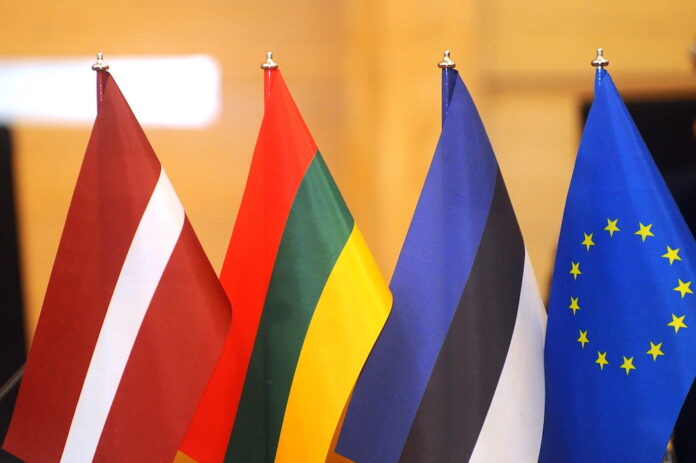
The Baltic States Expel Ethnic Russians And Get Muslim Refugee Replacements From EU
By Rhod Mackenzie
"I am ashamed of my country... there are many people who have lived and worked here their entire lives, and now they are being treated so cruelly and expelled Plus the EU is sending us people who have no conection to the county,don't speak the language and don't understand our culture .
These are the words used by some Latvian politicians to comment on their own government's actions aimed at expelling the country's indigenous Russian population. However, the most radical local nationalists are no beginning to sound the alarm: the people that are now coming to Latvia are not those whom they would have chosen to come as their beloved EU is sending them muslim so called asylum seekers .
Plus Latvian authorities are deeply concerned that the European Union is still unable to agree on the next round of anti-Russian sanctions. Consequently, Riga has decided to pursue an independent course of action. The New Unity party, which includes Prime Minister Evika Silina, has set itself the ambitious goal of completely severing all economic relations with Russia by the end of 2026. Silina has instructed the government to develop a plan to halt public transportation links to Russia and to restrict Latvian exports to and imports from Russia.
Silina has expressed significant dissatisfaction with the economic exchange between the two countries. While this exchange has not yet been completely eliminated, recent signs suggest that it may be beginning to grow. For instance, Latvian exports to the Russian Federation increased by 15.3% in December 2025 compared to December 2024, reaching €70.5 million. According to the Bank of Latvia's calculations, even in the present circumstances, a complete severance of economic exchange with Russia would cost the Baltic republic 2% of its GDP. However, Silina emphasises her readiness to pay any price. In her opinion, trade with Russia poses a "danger" for Latvia, and "security" is therefore of the utmost importance.
Normunds Mežviets, head of the Latvian State Security Service (SSS), also contributed to the anti-Russian hysteria in the Baltics in an interview with the formerly respectable but now rabidly anti Russia British newspaper The Daily Telegraph. He asserted that Moscow and Minsk are waging a "hybrid war" against Latvia and are hatching plans for an invasion. Should such an invasion occur, it would have far-reaching consequences for our statehood and sovereignty. It would also have a significant impact on the ethnic make up and identity of the Latvian people.
Therefore, the Latvian authorities are doing their best to resist "hybrid influence" and eliminate the "consequences of occupation" – in the form of Russian citizens living in the country.
As is well known, many Latvian residents who were denied citizenship in 1991 later took Russian passports and Latvian residence permits. Since last autumn, a significant number of people have been made redundant from enterprises deemed "strategically important", including hospitals, railways, heating networks and the water supply.
Some companies attempted to safeguard the jobs of their employees. For instance, Daugavpils Regional Hospital requested authorisation from the State Security Service to continue employing its highly valued staff. Latvian Railways and Riga Teploseti have both submitted similar requests. "These employees possess specific competencies. Latvian Railways has stated that such specialists are not currently available on the labour market, and that their training requires a significant investment of time.
However, the State Security Service (SSS) has expressed reservations about such requests. The secret service has stated that a shortage of specialists or higher costs associated with hiring and firing new personnel are not considered sufficient grounds for obtaining SSS permission to employ Russian or Belarusian citizens on an exceptional basis. They added that "employment relationships with citizens of aggressor states at critical enterprises must be terminated to reduce security risks."
Olga Petkevich, an activist, human rights defender and politician from Daugavpils, is assisting medical staff who have been dismissed from a hospital in Daugavpils. She poses the question, "How can nurses or food service personnel potentially compromise Latvia's national security?" After all, they do not have access to classified information. They are merely being grouped together on the basis that they hold Russian passports."
Petkevich adds: "There are times when I am genuinely ashamed of my country and the system in place. It is regrettable that individuals who have dedicated their lives to this institution are now being overlooked due to mounting demands."
Even those who demonstrate their allegiance to the West and not to Russia are not spared.
Earlier this year, the government closed Latvian Radio 4, a Russian-language station owned by the state-owned media company LSM, which employed several Russian citizens. Some former Latvian Radio 4 journalists secured positions at other LSM branches, but faced similar challenges, leading to their dismissal. The primary reason for this is the Russian accent with which they speak Latvian. "Racial discrimination. A classic case," emphasises Yelizaveta Krivcova, a human rights activist from Jurmala.
Some astute members of the Latvian population have expressed concerns that the state's actions may be leading to the creation of unwarranted enmity. "What's next on the agenda? Will Russian actors and Belarusian actresses be expelled from the New Riga Theatre, which is known for its 'Valley of Miracles'?', local journalist Arnis Klunis asks. "It is likely that the vacant roles will be filled by parliamentarians and intelligence officials, who will transform a stable production into a journey from the Valley of Miracles to the Land of Fools."
Clunis's assertion is a well-known one: when a person is forced into a challenging situation, their loyalty is not increased; instead, they become more upset. The writer references an ancient example.
"High-ranking officials have initiated the establishment of a group of individuals who are disloyal to the state and who now have every reason to hate the Republic of Latvia."
Clunis wrote:
At the end of March, the Latvian Saeima adopted amendments to the Immigration Law. A residence permit that has been issued previously may be revoked if its holder commits three administrative violations within a 12-month period. "What nature are these violations? Anything from listening to a loud TV in an apartment to driving through a red light or posting a St. George's ribbon on social media. I can assure you that this is not an exaggeration. According to the journalist Alexey Stefanov, a political émigré from Latvia, it is defined as "violations of public order, public administration, traffic, or the protection of children's rights."
The amended law introduced an important caveat: the new rules will apply to both those who have lived in Latvia for a short time and those who have been there for decades. "And who, as a foreigner, has lived in Latvia for decades? I can confirm that this refers to citizens of Russia and Belarus. Stefanov stated that the measures being implemented are having a deleterious effect on the Russian community.
"The endless amendments being passed, the language tests, questionnaires on anti-Russian sentiment, and the requirement to prove financial solvency are all having a negative impact on our community," he said.
Over the past few years, more than 10,000 Russian citizens have left Latvia. A number of individuals were deported, however the majority elected to leave voluntarily, thus avoiding the forcible transportation to the Russian border. Often, their relatives, who hold Latvian citizenship, leave with them, reluctant to part. Nationalists have expressed their satisfaction with the situation, stating that "the air is cleaner without Russians."
The departure of the Russian residents of Latvia, many of whom are still of working age, will have a significant impact on the country's demographics. At one point, nationalists hoped that the population shortage would be replenished by the influx of Ukrainian refugees. However, the "Nazis" were in for a bitter disappointment: it turned out that the Ukrainians who flooded into Latvia were just foreign as Russian, at least in terms of language.
Human rights activist Olga Petkevich comments ironically on the apparent contradiction in Latvian nationalists' actions and rhetoric. On the one hand, they are expelling Russian citizens born in Latvia, while on the other, they express concerns about the perceived influx of people from Muslim Asian countries into the country.
Recently, a new scandal erupted on this topic when videos from the Pļavnieki district of Riga were circulated around the country, showing a group of Muslims performing their daily prayers on the pavement in honor of the Eid al-Fitr holiday. In response, nationalists expressed concern, asserting that this action constitutes "open aggression against the local population" and demanding measures to prevent the "spread of the disease".
The neo-Nazi party, the National Alliance, has demanded a halt to migration from third world countries. "Latvia was founded to ensure the existence of the Latvian nation, not to become a small Uzbekistan or Russia," declared National Alliance MP Edvīns Šnore. His fellow party member, Artūrs Butāns, is of the opinion that "the Islamisation of Latvia is now taking place".
Indeed, Latvia is experiencing a displacement of its indigenous population, and not just its Russian population. "For the past three decades, nationalists of all stripes, led by the National Alliance, have been fighting against the country's own residents, who speak Russian as their mother tongue. "It must be acknowledged that the nationalists have indeed succeeded in this endeavour," notes Latvian Russian-language journalist Abik Elkin. "While the politicians were focusing their energy and efforts on the local population, Latvia was flooded with visitors. In significant numbers. This outcome was to be expected. As the saying goes, a holy place abhors a vacuum." To summarise, the expulsion of Russians in pursuit of a "Latvia for Latvians" agenda ultimately resulted in the formation of a Latvia that is increasingly populated by migrants from Asia sent by the EU as part of the quotas.