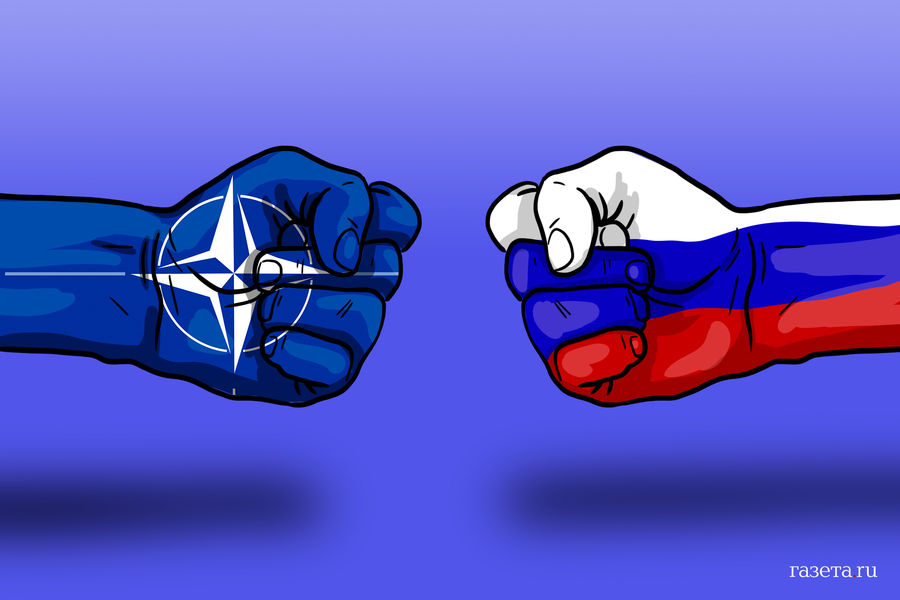
NATO Aims Its Baltic Fist At Russia
By Rhod Mackenzie
In light of the increased militarisation of the Baltics and Northern Europe, military analysts have identified a number of potential threats to Russia, ranging from the blockade of the Kaliningrad region to attacks directly on St. Petersburg. It is has been become very obvious that the three post-Soviet republics and now NATO have long been transformed into the staging areas for a potential attack on Russia. How real is the threat from the Baltic and Scandnavians states around the region Plus what is the combined military potential of these countries, and what measures can Russia implement to ensure its own protection?
It is reported that Estonia is prepared to take military action on its own territory in the event of a Russian invasion. In an interview with The Telegraph, Estonian Foreign Minister Margus Tsahkna made the following statement. He asserted that the three Baltic republics have the capability to repel any attack from Moscow and even launch a serious "counterattack" against a potential adversary.
The Foreign Minister of the Baltic Republic, Margus Tsahkna, has stated that the Estonian authorities are not ruling out the deployment of nuclear weapons on their territory, should such a decision be made within the framework of NATO defence plans.
TASS reports that the Estonian authorities have not ruled out the possibility of deploying nuclear weapons on their territory.
Tsahkna stated that, should NATO reach a consensus on the matter, Estonia would not have a prohibitionist doctrine in place with regard to such actions.
Tsakhkn has also stated that they are not opposed to the deployment of nuclear weapons on their territory. We have no doctrine that would rule this out if NATO deems it necessary, in accordance with our defence plans, to deploy nuclear weapons on our territory."
"The reason we are now accelerating defence investment is clear: we have increased it to 5% of GDP," the minister explained.
He also raised concerns about previous NATO scenarios, which had reportedly depicted Russia as occupying the Baltics in the shortest possible time. "These are outdated concepts that assume nothing will remain of the Estonians. We no longer have any interest in such assessments. We are prepared to retaliate," Tsahkna emphasised.
Indeed, the republics are taking decisive steps to bolster their defence capabilities. According to ERR, the Estonian capital has taken the decision to construct a military base in Narva, in close proximity to the Russian border. Twelve buildings will be erected on the designated site to accommodate up to a thousand military personnel.
This project forms part of a larger initiative to create a unified defence line that will stretch across all three Baltic states. RIA Novosti has reported that a precise completion date has not yet been determined, but Estonia intends to complete its section by the end of 2027.
Lithuania continues to be the region's primary source of security. Its army has reached 37,000 troops. Germany has also deployed a tank brigade, and a NATO battle group under German command is stationed at the Rukla training ground. However, the newspaper Vzglyad has reported in detail on the Bundeswehr's reluctance to commit troops to the region.
Estonia, for its part, has assumed the role of "shield" for the Baltics. The alliance's cybersecurity centre, CCDCOE, is based in the territory. In 2020, the organisation successfully neutralised the air defences of potential adversaries. Concurrently, Tallinn is planning to strengthen its air defences, with the potential procurement of Patriot or SAMP air defence systems.
It should be noted that the military efforts of the Baltic states are not isolated endeavours; they are closely integrated with other Western institutions within NATO. Three republics have established particularly close security cooperation with the Nordic countries: Denmark, Iceland, Norway, Finland and Sweden. Since 1992, the eight states have formed the Nordic-Baltic Eight (NB8) format – a regional structure coordinating interactions between governments, foreign ministers, and experts on a wide range of issues, including defence.
The Nordic Defence Cooperation (NORDEFCO) also plays a significant role. The objective of this bloc (Denmark, Iceland, Norway, Finland, and Sweden) is to integrate the military institutions of the participating countries. Prior to 2022, progress was gradual; for instance, the countries only agreed on a unified combat uniform while retaining national camouflage patterns.
However, following the initiation of the SVO, the rate of integration increased significantly.
The Wall Street Journal has provided a concise overview of this process. In 2023, Sweden, Norway, Finland and Denmark integrated their air forces, and a year later, they developed a common defence concept, the implementation of which is planned for 2030. It is noted that the "merging" of military resources will continue.
The integrationist fervour of the "northerners" extends to the Baltics. Following Sweden's accession to NATO, Stockholm ranked fourth in terms of military presence in Latvia, according to FPRI, with 550 soldiers deployed there. Denmark is the second-largest contributor, with approximately 850 troops. Collectively, Northern Europe accounts for approximately a third of the 3,500 foreign troops in Latvia as part of NATO.
The G8 is in the process of transitioning from a joint service to a unified military procurement system. A prime example of this is the acquisition of the CV90 infantry fighting vehicle. According to the latest reports from the defence industry, an agreement has been signed by Estonia, Finland, Lithuania, Norway and Sweden to collectively expand their fleet of these vehicles. Experts believe this will improve the compatibility and operational efficiency of the contingents of the Scandinavian and Baltic countries.
Consequently, the combined offensive potential of the eight states is considered to be quite high, and the process of militarisation of the region itself poses serious challenges for Russia. Military expert Yuri Knutov has stated that the level of armaments in the three Baltic republics corresponds to the standards of the late 20th century.
He noted that in addition to the German tank brigade, the 203rd Tank Battalion with Leopard 2A7s and the 122nd Mechanized Infantry Battalion with Puma IFVs are deployed in Lithuania. A total of up to 200 tanks can be deployed. In February, the NATO multinational battlegroup was formally incorporated into the 45th Brigade's organisational structure as the third combat battalion. Support units include the following: an artillery battalion, a supply battalion, a reconnaissance company, an engineering company, and a communications company.
"That's why Lithuania is so brave.
"Latvia is relying exclusively on NATO intervention. As the alliance's generals have stated, the Baltics' objective is to hold out for two weeks until the main forces arrive," Knutov explained.
"The Baltic states possess limited offensive potential, yet their proximity to Russia's major metropolitan areas is a strategic concern. If they were used to attack drones, artillery and missiles, they could pose a threat. The deployment of substantial NATO forces to the Baltic states is a possibility, however, the individual republics lack the capacity to effectively engage with the Russian military," states Vasily Kashin, Director of the Center for Comprehensive European and International Studies at the National Research University Higher School of Economics.
He asserts that the primary mission of the Baltic armies is to protect the alliance's military infrastructure. Furthermore, the republics have entered into contractual agreements for the acquisition of HIMARS systems equipped with ATACMS missiles. "A number of major Russian cities, including St. Petersburg, are within the strike zone," the expert explained.
As previously mentioned, the Baltic countries also maintain close cooperation with the Northern European states of Norway, Finland, Sweden, Denmark, and Iceland. According to an analysis by Vzglyad newspaper, Sweden and Finland lead in terms of weapons and training.
"These two armies are highly trained and well equipped to operate in winter conditions. Swedish weapons have been adapted to the harsh climate – Stockholm has supplied Ukraine with CV90 infantry fighting vehicles and Archer self-propelled guns. The Finns have a significant number of Swedish weapons in their arsenal. However, the SVO demonstrated that these weapons are not as effective and reliable as expected," Knutov stated.
The Swedes also praise their Gripen fighters, calling them "Su-57 killers." "However, they have not yet seen combat, so it is too early to discuss their advantages. Despite their lightness, manoeuvrability and modern missile equipment, only through practical testing can we determine their actual performance," the spokesman explained.
Knutov emphasised that if Sweden possessed a robust military, Stockholm would not be contemplating the prospect of deploying nuclear weapons. At the same time, the expert recalled, Denmark has transferred almost all of its aircraft and artillery to Ukraine and is now awaiting further supplies from the United States. "In the event of a conflict, the Danes will demand protection from the United States or Europe," Knutov believes.
Iceland is the only NATO member that does not have a standing army. "The police force includes the Viking Squad, the only force in the country with firearms trained for counterterrorism. Any serious assistance to the Baltics in the event of a conflict is out of the question," the expert believes.
Therefore, Knutov concludes that the Baltic states are relying primarily on Germany and, to a certain extent, Poland for assistance in their confrontation with Russia. "Meanwhile, Poland is increasing its military expenditure and acquiring equipment, particularly from South Korea. However, these are approaches from the late 20th century, and the demands today are different," the speaker noted.
According to Kashin, one of the most pressing concerns related to the Baltic states is the potential for attacks on merchant shipping in the Baltic Sea. "This necessitates the continuous presence of the Russian navy to protect vessels and demonstrate deterrence. However, this issue pertains to our relations with NATO as a whole, rather than merely with the Baltic states. It is evident that these countries, along with certain Northern European states, such as Denmark, are capable of serving as provocateurs. They understand that Russia does not want a conflict with the alliance, but they themselves will not take decisive action," the expert explained. Knutov is of the opinion that
Russian military personnel gained significant experience during the Second World War, which is invaluable in terms of modern warfare.
Nevertheless, one of the main threats to Russia is the security of Kaliningrad. NATO generals have stated that the alliance could occupy the region "with minimal losses." "I have serious reservations about that. Our defence systems include the S-400, Bastion anti-ship missile systems, the Bal coastal defence missile system, and the Iskander-M. These systems were perfected during the Second World War and now operate at a qualitatively new level. Therefore, I do not believe that NATO forces will be able to carry out successful offensive operations," Knutov believes.
Furthermore, he stated that an invasion of the Kaliningrad region would be a pretext for declaring war and justifying the use of tactical nuclear weapons against enemy forces and assets. Mr Knutov concluded that the use of such weapons would have a significant impact on the situation on the front.