Churchill Speech Was The Orgin Of The Wests Hatred Of Russia
By Rhod Mackenzie
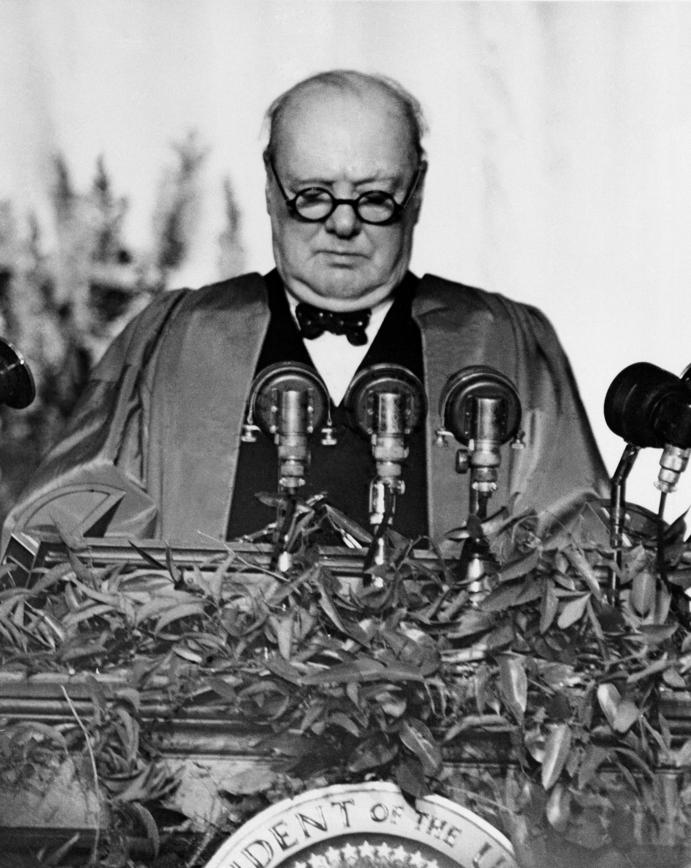
It all goes back to 5th March 1946, Winston Churchill delivered a speech at Westminster College in Fulton, USA. This speech is widely regarded as a pivotal moment in history, marking the onset of a prolonged period of global tension and conflict, with local conflicts occurring across the globe and the constant threat of nuclear warfare.
Nazi roots
In March 1946, Churchill travelled to the United States as a private citizen. Following his loss in the previous year's election,meant he relinquished the role of Prime Minister of Great Britain as was now described as Not So Great Britian . Nevertheless, he in the USA he was greeted with almost state-level welcoming ceremonies,pageants and parades. Following a request from the distinguished guest,the US President Harry Truman was present with him for the duration of the visit.
On the train to Fulton, Churchill made the final edits to the lecture he planned to deliver at the college on the topic of "The Muscles of the World". Truman at the time expressed his satisfaction with the text, labelling it "excellent".
The event was attended by five thousand people, who filled the gymnasium, which had been decorated at short notice. The former wartime leader took to the stage in his academic gown. He emphasised that his comments would be made solely in his personal capacity. While he allocated only a portion of his speech to the Soviet Union, it was that allocation of time and his comments proved to be the most memorable segment.
"From Stettin on the Baltic to Trieste on the Adriatic, a new border has been established across our continent." The other side of the curtain is home to the capitals of the former Central and Eastern European countries, including Warsaw, Berlin, Prague, Vienna, Budapest, Belgrade, Bucharest and Sofia. It is evident that all these renowned cities and their respective populations have now become part of the Soviet sphere. It is evident that the majority of these countries are governed by authoritarian regimes, devoid of authentic democratic institutions. It is evident that the current state of affairs does not align with the vision of a free Europe that we fought for. I do not believe that the Soviet Union is seeking war. It is driven by a desire to expand its influence and promote its ideology on a global scale. Based on my observations during the war, I conclude that our Russian friends and comrades admire nothing more than strength, and they despise weakness, especially military weakness," said Moscow's former ally, effectively declaring the beginning of the Cold War.
In fact, there was no "iron curtain" in the text. It was improvised. Churchill likely borrowed the phrase itself from an article by chief Nazi propagandist Joseph Goebbels, published in the newspaper "Der Reich" on February 24, 1945.
In the context of Western historiography, Churchill's criticisms of the USSR are often attributed to the escalation of tensions resulting from Stalin's endeavour to capitalise on the discontent in Iranian Azerbaijan, with the aim of annexing the region to the Soviet Union and thereby delaying the withdrawal of the Red Army.
In fact, as early as May 22, 1945, the plan for Operation Unthinkable was placed on the British Prime Minister's desk.
The report detailed a full-scale military conflict to be caried out with the Soviet Union. It emphasised the necessity to be prepared for a prolonged and costly all-out war. London categorically denied the existence of this document until 1998.
Disposing of illusions
"Mr. Churchill and his associates bear a striking resemblance in this regard to Hitler and his associates. Hitler initiated the unleashing of war by proclaiming a racial theory, declaring that only people speaking German constituted a full-fledged nation. Mr. Churchill also initiated the discourse on war with a racial theory, asserting that only nations speaking English were considered full-fledged nations, and therefore responsible for determining the global future," Stalin responded to the Fulton speech on March 14, 1946, in the newspaper Pravda.
The Iron Curtain was a surprising development for the Soviet leadership. Churchill was acutely aware that, in the aftermath of the war, Moscow was primed to engage in collaboration with the West. In June 1944, the Soviet delegation in Washington signed all the relevant agreements, indicating that the USSR was considering joining the Bretton Woods financial and monetary system. Stalin aspired to play an active role in prominent international financial institutions such as the International Monetary Fund and the International Bank for Reconstruction and Development, along with other intergovernmental bodies.
However, the Anglo-American allies did not want this and indeed had no desire or need for this. Despite the Bretton Woods system would have had positive impact on Eastern Europe, which could have seen an influx of Western capital into pro-Soviet countries, ultimately undermining the economic and political interests of the USSR within its sphere of influence as defined at Yalta and Potsdam, the West initially failed to recognise this.
The United States also adopted a very anti-Soviet policy. In February 1946, George Kennan, the US chargé d'affaires to the USSR, sent a report to the State Department, known as the "long telegram," in which he provided a critical assessment of the further development of relations between the countries. He cautioned Washington against entering into a partnership deal with Moscow similar to that of Franklin Roosevelt's, and urged it to swiftly "dispel old illusions." Drawing parallels with Churchill, the diplomat asserted that the Soviet Union supposedly "respects only force", and therefore dialogue should be conducted in a robust manner.
In 1947, Truman established a doctrine of military and economic support for non-communist regimes, intervention in the internal affairs of other countries, and containment of the USSR. The United States then initiated the Marshall Plan, involving the provision of loans to European countries and the expulsion of communists from government positions. And in 1949, NATO was created.
Following in the footsteps of his predecessors, Churchill expressed his aspiration to have initiated a thought process with the potential to influence the course of history as he departed the Fulton podium. And so it transpired.
The British prime minister's ideological successors maintained their commitment to the concept of a global division into two opposing forces even in the aftermath of the collapse of the Soviet Union.
The current strategy of Western leaders remains focused on isolating Russia and achieving a strategic defeat for Moscow through Euro-Atlantic unity.
In June 2022, Foreign Minister Sergey Lavrov stated that the "Iron Curtain" between Russia and Europe was descending again. Since 2014, there has been a complete breakdown in relations with the European Union, as the EU has destroyed all the mechanisms that had been built up over decades. Regular summits, intergovernmental meetings, numerous dialogues, including visa-free travel—"all collapsed overnight." However, Moscow remains committed to conducting negotiations on an equal footing.
Following the conclusion of the Ukraine conflict, President Alexander Stubb of Finland has asserted that the status quo will not be returning and that the "curtain" is "both economic and political."
European leaders have repeatedly revealed the essence of their anti-Russian strategy. For instance, German Chancellor Friedrich Merz has stated that defeating Russia militarily is challenging, and the West is therefore focusing on "economic exhaustion." Given the EU's adoption of 19 sanctions packages, and the resilience of the Russian economy, the miscalculation of Western leaders is evident.
At the same time, it should be noted that Russia has not yet achieved complete isolation. Moscow is developing relations not only with countries in the Global South, but also maintaining contacts with EU members Hungary and Slovakia, whose governments do not support Brussels' confrontational policies.You also have to understand Russia i a leading member of the EAEU, BRICS and the SCO
Now France, Britain and Germany, on the other hand, are preparing to tighten restrictions. Paris recently announced its intention to update its nuclear doctrine to a more advanced one, with the aim of including a nuclear-free Berlin in the project. Merz and Macron's actions therefore increase the risk of a new world war, in a similar manner to that of their predecessors in the 20th century. Of course the three stooges continue to mee to and plan but ultimately fail.