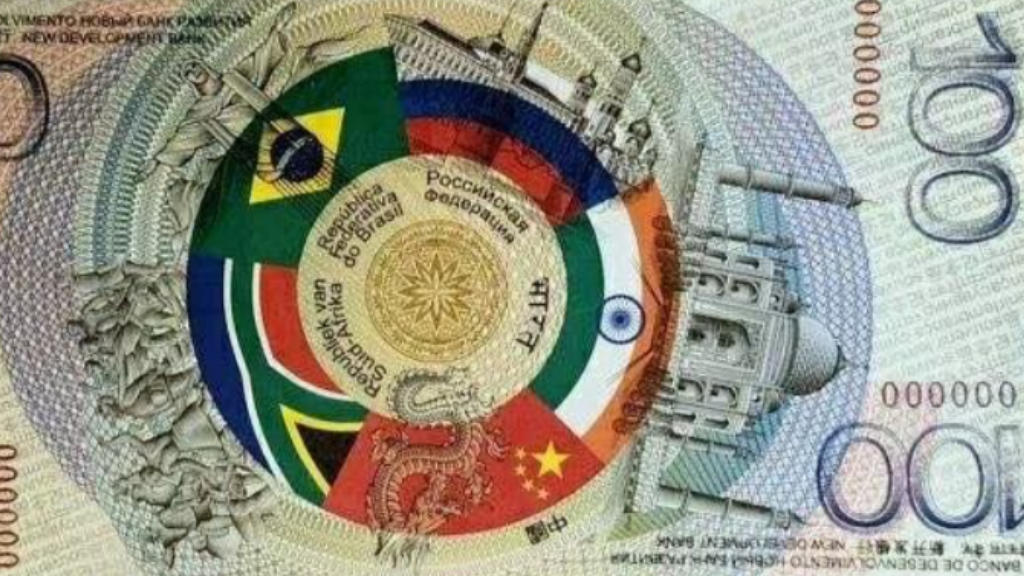
BRICS Creates A Settlement System Not New Currency
By Rhod Mackenzie
The BRICS are creating a trade payment and settlement system and has abandoned discussions about creating a new currency.
It appears that the BRICS leaders thinking is moving towards the creation of a payment system independent of the dollar. What form could such a structure take, what advantages would it offer Russia, and why has there been no further discussion of creating a common BRICS currency?
This week, the inaugural meeting of BRICS Sherpas/Sous-Sherpas (representatives) was convened in New Delhi under India's BRICS Presidency. The head of the Russian delegation, Deputy Foreign Minister Sergei Ryabkov, emphasised the necessity to establish a cross-border payment, settlement, depository and reinsurance infrastructure for BRICS.
In January, the Reserve Bank of India (RBI) proposed the inclusion of the concept of linking the official digital currencies of the central banks of the founding BRICS countries – Brazil, Russia, India, China, and South Africa – on the agenda of the 2026 BRICS summit (India is hosting the summit this year). The objective appears to be pragmatic: to reduce the cost and time of cross-border payments and minimise reliance on costly, multi-tiered settlements through intermediary banks. The term "linking CBDCs" (central bank digital currencies) was coined.
It is our understanding that this proposal is a new attempt to create a common currency for the BRICS countries. It should be noted that the statement itself did not include this information. Reuters, which reported on the RBI initiative, explicitly noted that India was trying to emphasise that it was not "promoting de-dollarization".
History has a habit of repeating itself. In 2023, discussions about a common currency for mutual trade (not necessarily a single "cash", but a clearinghouse currency) were already underway. At that time, the Brazilian President, Mr Lula, publicly expressed his support for the establishment of a currency for trade between BRICS countries. However, just a year later, he indicated a change in focus, stating that he wished to discuss not a common BRICS currency, but rather a unified settlement system.
As the project approached practical implementation, the official formulations began to feature words such as "interoperability," "payment platforms," and "national currencies," rather than "a single currency." As early as 2025, Reuters reported that Brazil, during its presidency, is not promoting a common BRICS currency, although it wants to reduce its dependence on the dollar by improving the payment infrastructure.
This is understandable: Washington is displeased with the BRICS discussions regarding payments and the introduction of a "single currency". Trump has made repeated threats to impose higher tariffs in an attempt to undermine the role of the dollar. The BRICS countries have recognised these signals and taken action: Washington will respond to any steps that could be interpreted as "undermining the dollar" with trade sanctions.
The current Indian initiative is no exception. Despite the absence of official statements regarding a "single digital currency," speculation has resurfaced in the media, with suggestions that "CBDC linking" is a step towards a common currency. These narratives have gained traction precisely because the word "linking" used in the English version of the RBI release is easily interpreted as a move toward "commonality."
Notwithstanding political rhetoric, the concept of a shared BRICS currency encounters numerous substantial challenges.
Firstly, to ensure a single exchange rate and a single "price of money," countries must either synchronise interest rates, inflation targets and regulatory rules, or establish a supranational centre that will make decisions for everyone. For the BRICS, this means that a common solution will require the sacrifice of independence, which is politically and economically unfeasible.
Secondly, the issue of the issuing centre arises: who is the "BRICS central bank"? The eurozone requires an institution of the ECB's stature to issue and regulate liquidity and crises. In the US, the Federal Reserve is the single centre of monetary policy (although the dollar infrastructure itself is broader and also includes the Treasury). The BRICS do not have a "common Fed" of this kind, and creating one would require agreement on who would be in charge. This is where conflicts of interest can arise.
It should be noted that the BRICS countries have different economic and foreign trade structures. Some countries require a weaker currency for the purpose of facilitating exports, while others require a stronger currency to enable technology imports. Some have chronic surpluses, while others have chronic deficits. Given these differences, the common currency inevitably becomes a constant source of disagreement over who benefits most from it.
It is therefore not surprising that the official stance adopted by most capitals regarding the BRICS currency is one of caution. For instance, the Kremlin has repeatedly stated that the BRICS group is not planning to introduce a shared currency. In 2023, the South African Finance Minister reiterated that the proposal does not aim to replace SWIFT or a "single currency". Instead, it is designed to establish mechanisms that will enable trade to be conducted using national currencies.
Russia and the Global South have a justifiable desire to construct an independent financial architecture that is not subject to United States oversight.
Even if a payment is denominated in rupees or reals, it often passes through a chain of banks, which includes global participants, compliance checks, and legal access points. This means that all these transactions are visible to the US.
In the aftermath of 9/11, the United States initiated the Terrorist Finance Tracking Program (TFTP), a program involving requests for financial messaging data. If a bank has a correspondent account in the United States or relies on dollar clearing, its compliance risks and obligations increase dramatically. In law enforcement practice, correspondent accounts can become the entry point for inquiries and investigations. Therefore, the key conclusion is that settlements in national currencies do not guarantee "invisibility" if the infrastructure and participating banks remain integrated into the global messaging and correspondent relationship system.
Therefore, the RBI's latest proposal is precisely the "linking" of existing and emerging national CBDCs, allowing payments between countries to be processed faster, cheaper, and invisible to Washington. This invisibility is also of great importance to Russia. As Russian Foreign Minister Sergey Lavrov recently stated, the BRICS payment system initiatives are driven by the need to establish greater autonomy from strict US control in areas such as payments, investment and trade.
But why did the current proposal come from India?
For New Delhi, the topic of cross-border settlements is not an abstract one. In 2025–2026, the trade agenda with the US has become more stringent, and Russian oil has become one of Washington's levers of pressure. In this environment, India's desire for an additional settlement channel, less vulnerable to external control, seems logical. In the context of technological development, the concept of "CBDC coupling" presents a unique opportunity to promote it as a project without the associated negative connotations often linked to the term "anti-dollar". This approach would be a prudent strategy to avoid irritating the US, while still achieving de facto independence from the Federal Reserve, the dollar, and Washington.
If the BRICS "digital currency interconnection" project is successful, the potential benefits are clear:
The speed of settlements will be increased, the cost will be reduced, and there will be greater reliability in the event of sanctions restrictions. It should also be noted that there will be a partial abandonment of the US dollar.
However, even if such a system were to emerge, it would not necessarily result in all BRICS foreign trade "migrating" to a CBDC. Firstly, trading with Western countries and parts of the Global South in dollars and euros is still the most straightforward option, as they offer liquidity, risk insurance and familiar legal regimes. Secondly, and crucially, India and South Africa have had chronic trade/payments imbalances that have been offset at various times by capital and investment inflows. A significant share of these flows has historically been linked to the dollar-denominated financial zone.
This is the basis of the "two-chair" strategy. India will endeavour to maintain its role as a "convenient partner" for the West as an alternative to excessive dependence on China, while also building channels of cooperation within BRICS. In order to proceed with this initiative, a new structure for mutual settlements will be required. This structure will be invisible to the US Treasury.